 Skip to content


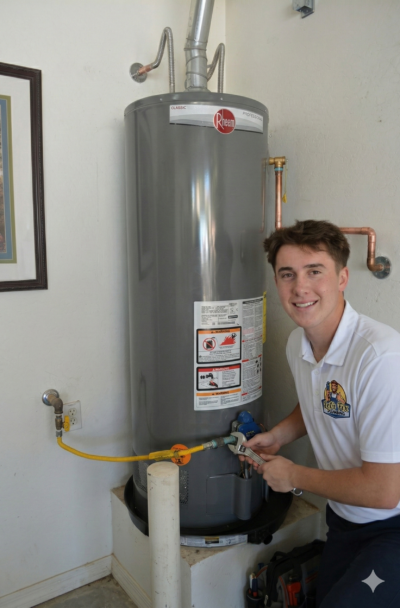
Utah water comes out of the tap hard. Salt Lake City, Ogden, Provo, Orem, West Jordan, and surrounding communities along the Wasatch Front pull water from sources delivering hardness in the 15-30 grains per gallon range — well into the “very hard” category. That mineral load shortens the life of every plumbing fixture and appliance in your home, and over a decade or two it costs more in equipment replacements than a softener would have cost to install up front.
What hard water actually is
Hard water has elevated calcium and magnesium dissolved in solution. The minerals come out of solution and deposit as scale when water heats, evaporates, or sits in pipes and fixtures. The USGS overview of water hardness rates anything over 10 grains per gallon as “very hard.” Most of the Wasatch Front tests well into that range.
What hard water does to plumbing
Calcium and magnesium scale coats the inside of supply lines, reducing flow over years. It builds up on water heater elements and tank bottoms, reducing efficiency and shortening tank life. It clogs faucet aerators and showerhead nozzles. It leaves spots on glass, dishware, and chrome. It dries skin and hair.
The water heater impact
Scale at the bottom of a tank insulates the burner or element from the water. The unit works harder, runs longer, and reaches end of life 30-40% earlier than a unit on softened water. A 12-year unit lasts 8.
Whole-house softener basics
A whole-house softener uses ion exchange to remove calcium and magnesium, replacing them with sodium or potassium. It regenerates automatically. Properly sized for a typical Utah home, installed cost runs $2,500-4,500. The DOE water heating guidance documents how scale reduction improves heater efficiency by 20-30%.
Other options
Salt-free conditioners change the structure of minerals so they do not deposit as scale, but they do not actually remove the minerals. Appropriate where sodium addition is a concern. Reverse osmosis under-sink systems treat only drinking water.
HVAC interaction
Heating and cooling systems that share infrastructure with water heating — combination boilers, hydronic systems, humidifiers — all see accelerated damage from hard water. Professional commercial and residential HVAC system service often coordinates with plumbing for whole-home softener installation. For comprehensive HVAC programs that pair with plumbing modernization, full-service residential HVAC maintenance services handle the coordination side.
Maintenance after installation
Refill the salt or potassium tank every 1-3 months depending on household water use. Replace the resin bed every 8-12 years. Have the softener inspected annually for proper operation.
Your Utah Hard Water Specialists
At Let’s Fix Plumbing, we install whole-house water softeners across Syracuse, Salt Lake City, Ogden, Provo, Orem, West Jordan, and surrounding Utah communities. Contact Us for a water hardness test and softener proposal. Our water softener services cover the full Wasatch Front.
What Hard Water Costs a Utah Home, Fixture by Fixture
The mineral load does not attack one thing. It works through the house in order of how much heat and how much flow each part sees, which is why the water heater goes first and the shower valve goes last. Below is the order most Utah homes experience it in, and what each item is actually telling you when it starts to misbehave.
| Where it shows | What is happening | What it usually means next |
|---|---|---|
| Rumbling from the water heater | Water boiling under a sediment layer on the tank floor | Flush it, and start planning if the tank is old |
| Hot water runs out sooner than it used to | Sediment has taken up part of the tank volume | Replacement, and a softener ahead of the new tank |
| Shower pressure falling off over years | Scale plating the inside of supply lines | Descaling fixtures buys time, repiping fixes it |
| Cloudy glassware and soap that will not lather | Calcium and magnesium in solution | Softening is the only thing that changes it |
| A tankless unit faulting or underperforming | Scale in the narrow passages of the heat exchanger | A descaling flush, then a schedule for it |
| Dishwasher and washing machine failing early | Scale on heating elements and valves | Softened water protects the replacements |
| Aerators blocking within months | Scale flaking off from upstream | A symptom of what the pipes look like inside |
Hard Water and the Wasatch Front Housing Stock
The same water reaches very different houses, and the age of the plumbing decides what it does to them. In the older streets of Salt Lake City, the Avenues and Sugar House, and in older Ogden, galvanized steel is still in service. Scale and rust close it from the inside until pressure is visibly gone, and no amount of treatment reopens a pipe that has already narrowed. In houses built through the copper decades, the failure is a pinhole rather than a blockage, and scale creates the turbulent spots where pinholes start.
Newer builds across Utah County, West Jordan, Sandy and Draper are usually plumbed in plastic, which does not corrode. That removes one problem and leaves the other: every appliance and every heater on those lines still takes the full mineral load. A ten-year-old house with a dead water heater and a spotless shower door is not an unusual call here.
The Three Jobs Hard Water Sends Us To
Almost every hard water conversation ends at one of three doors. The first is water softener installation, which is the only measure that changes the water rather than the symptom, and the one that protects everything downstream of it. The second is water heater replacement, because the heater is where the mineral collects fastest and it is usually the first appliance to be lost. The third is a whole-house repipe, which comes up when the pipe itself has closed up or started leaking and treatment has arrived too late to save it.
The order matters. Softening after a repipe protects the new pipe. Softening after a heater replacement protects the new tank. Softening a house whose galvanized lines are already three-quarters closed does not give the pressure back, which is why the two jobs are usually priced together rather than one after the other.
Utah Hard Water FAQs
How hard is the water in Utah?
Hard enough to be the defining plumbing problem of the Wasatch Front. This page puts the range at 15 to 30 grains per gallon across Salt Lake City, Ogden, Provo, Orem, West Jordan and the surrounding communities, against a USGS classification that treats anything over 10 grains per gallon as very hard. Your own water provider publishes an annual water quality report with the figure for your supply.
Is hard water in Utah dangerous to drink?
Calcium and magnesium in water are minerals rather than contaminants, and hardness is a nuisance and equipment issue rather than a health one. What it damages is plumbing, heaters and appliances. If drinking water quality is the concern, that is a filtration question and it is answered separately from softening.
Do water conditioners work as well as softeners?
They do a different job. A softener removes hardness minerals by exchange, so the water leaving it is genuinely soft. A conditioner alters how the minerals behave so they are less inclined to stick, without removing them. Some homeowners are satisfied with that outcome, and some are not, and the honest answer is that they are not the same product with different names.
Will a softener undo scale that is already in my pipes?
No. Softening stops new scale forming; it does not dissolve what is already plated onto the inside of a supply line or baked onto the floor of a water heater. That is the argument for doing it before the pipes and the heater are lost, rather than after.
Which appliance does hard water kill first?
The water heater, almost always, because it applies heat and heat is what drops the minerals out of solution. Dishwashers and washing machines follow, since both heat water and both have valves and elements for scale to collect on. Fixtures and aerators are the visible end of the same process.
Do I need a softener if my house has plastic pipe?
Plastic will not corrode, so the pipe itself is safe. Everything connected to it is not. The water heater, the dishwasher, the washing machine, a tankless heat exchanger and every fixture in the house all take the same mineral load whatever the supply lines are made of.
Hard Water Services Across Utah
Where to go next depending on what the water has already done: water softeners for repair and replacement of an existing unit, water softener installation in Salt Lake City for a first install, water heater installation and repair, tankless water heaters which are the most scale-sensitive of all, whole-house repiping in Salt Lake City, leak detection when a pinhole has already started, and water heater replacement in Orem for Utah County.
Talk to Us About Utah Hard Water
Tell us what the water is doing in your house, how old the plumbing is, and whether there is a softener already, and we can tell you which of the three jobs above you are actually looking at. To talk it through with Lets Fix Plumbing, call (801) 346-9896 or send the details through the form below.