 Skip to content
Across the diverse communities of South Jordan, a functional sewer line is essential for daily life. Signs like gurgling drains, foul odors, or soggy spots in your yard all point to a serious issue underground.
Let's Fix Plumbing is your dedicated partner for all sewer line repair and replacement needs, serving properties throughout South Jordan, 84095 with precision and professionalism. We are committed to protecting your property. Visit our website to connect with our team and book your sewer service today.
Protect Your Foundation: Why a Small Sewer Leak Is a Major Structural Threat
Your home’s foundation is its most critical asset, and one of its greatest silent enemies is a leaking sewer line. A cracked or separated sewer pipe doesn't just waste water or create a bad smell; it actively undermines the structural integrity of your entire property by releasing a steady flow of water directly into the soil that supports your foundation. This is not just a plumbing problem; it's a direct threat to your home's stability. At Let's Fix Plumbing, we help homeowners across South Jordan, 84095 diagnose and stop these leaks before they lead to catastrophic and expensive structural failure.
How a Broken Sewer Pipe Destroys Foundations
This destructive process happens slowly, silently, and directly beneath your feet. Any sewer pipe that runs under or near your home’s slab or footings becomes a liability the moment it’s breached.
- Soil Oversaturation: A leaking pipe constantly saturates the compacted soil around your foundation. Soil that is supposed to be stable and supportive turns into unstable, muddy slurry.
- Erosion and Soil Washout: The constant flow of water—even from a small crack—begins to slowly wash away the fine particles of soil (like sand and silt) that provide the structural support for the concrete.
- Void Creation: Over time, this erosion creates an empty space, or "void," directly beneath your concrete slab or foundation footing. The foundation is now spanning over hollow ground, bearing the entire weight of your house without support from below.
- Settling, Shifting, and Cracking: Gravity always wins. The immense weight of the house forces the unsupported section of the foundation to sink, settle, or shift into the void. This movement is what causes diagonal cracks in your basement walls, uneven floors, sticking doors and windows, and cracked drywall seams inside your home.
Our Solution: Secure Your Line, Save Your Foundation
By the time you see cracks in your drywall, the damage to your foundation is already significant. The key is to address the cause (the sewer leak) the moment it's suspected. If you have recurring clogs, foul odors, or soggy spots near your home, you must investigate the sewer line immediately.
- Advanced Camera Diagnosis: We don’t guess. We send a high-definition sewer camera through your plumbing to visually inspect the critical area where the pipe runs under or exits your foundation. We can see the exact crack, offset joint, or root intrusion that is causing the leak.
- Pinpoint the Breach: Our camera equipment allows us to pinpoint the exact location and depth of the failure, so we know precisely where the erosion is occurring.
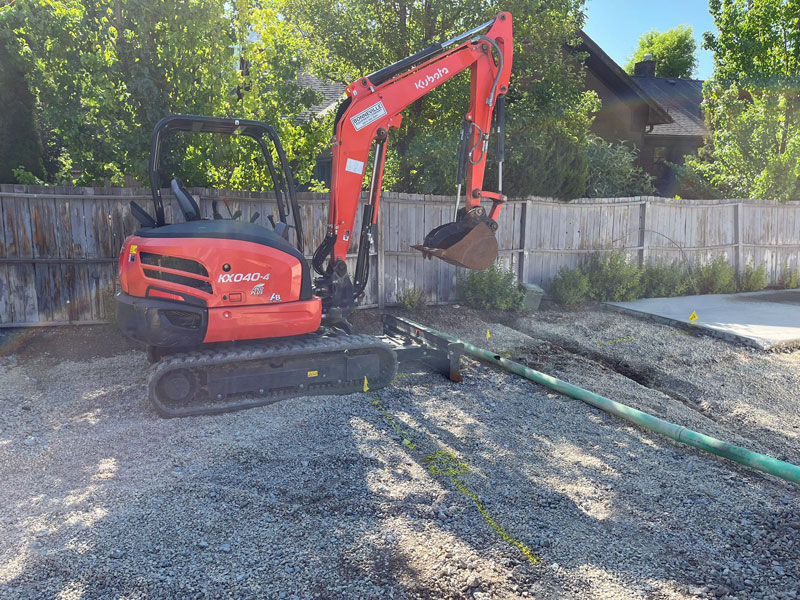
- Trenchless "No-Dig" Repair: The last thing you want near a vulnerable foundation is a massive, disruptive excavation. Our modern, trenchless CIPP (Cured-In-Place-Pipe) lining process is the perfect solution. We can insert a new structural liner into the old pipe and cure it in place, sealing the leak permanently from the inside.
- Stop the Damage, Permanently: This "no-dig" repair requires no destructive trenching next to your home. It immediately stops the leak, preventing any further soil erosion and allowing the ground around your foundation to stabilize. This single plumbing repair can save you tens of thousands of dollars in future foundation leveling and structural concrete work.
Don't Wait for a Catastrophe: Proactive Sewer Line Solutions Are Here.
The worst time to deal with your sewer line is when it’s an emergency—think a raw sewage backup in your basement on a holiday weekend. This "catastrophe" scenario is stressful, messy, and far more expensive than planned maintenance. The smart, modern alternative is a proactive approach. At Let's Fix Plumbing, we provide homeowners across South Jordan with proactive solutions to identify and repair sewer line issues on your schedule, saving you from the panic and expense of an inevitable system failure.
Key Risk Factors: Should You Be Proactive?
You don't need to wait for a disaster to take action. If you own property in South Jordan, you are at high risk for a future sewer failure if any of these apply to you:
- Your Home's Age: Many homes in our area were built before 1980. This means your property likely has its original sewer line made of vitrified clay, cast iron, or even Orangeburg (bituminous fiber pipe). These materials are all past their 50-year intended lifespan and are highly susceptible to cracks, corrosion, root intrusion, and collapse.
- You Have Mature Trees: Large, beautiful trees are the number one cause of sewer line failure. Their roots are naturally drawn to the water and nutrients in your sewer pipe and will actively break in to get them.
- You Experience Minor Warning Signs: Do your toilets gurgle? Do a few drains run slow? These aren't "quirks"—they are the earliest warning signs that your main line is partially blocked and struggling.
- You Are Buying or Selling a Home: A standard home inspection does not cover the sewer lateral. A proactive sewer camera inspection is the only way to avoid buying (or selling) a home with a hidden, $20,000 problem lurking underground.
Our Proactive Solutions for Total Peace of Mind
Being proactive means moving from reacting to an emergency to preventing one. We provide the tools and expertise to give you complete control over your plumbing's health.
- The "Pipe Physical" (Sewer Camera Inspection): This is the single most important proactive step. For a minimal cost, we feed a high-definition camera through your entire sewer line. This is a non-invasive "health check-up" that gives you hard data, showing you the exact condition of your pipe. We can spot early-stage root intrusion, small cracks, or developing sags (bellies) long before they become a disaster.
- Preventative Hydro-Jetting: If our inspection reveals heavy sludge, grease, or early root growth in an otherwise intact pipe, we can perform a preventative cleaning. Our high-pressure hydro-jetter scours the pipe walls clean, restoring its full diameter and washing away the blockages before they can cause a backup.
- Proactive Pipe Lining (CIPP): This is the ultimate proactive solution. If your pipe is old and cracked but not yet collapsed, we can use trenchless Cured-In-Place-Pipe (CIPP) lining. This process inserts a resin-saturated liner into your old pipe and cures it, creating a brand new, rock-hard, joint-free pipe inside the old one. This permanently seals all cracks, stops roots from ever getting back in, and adds 50+ years of life to your system—all without excavation and on your timeline.
Why Choose Let's Fix Plumbing
- Locally Owned & Operated
- 24/7 Emergency Services
- Licensed & Uniformed Technicians
- 5-Star Google and Yelp Reviews
- Upfront Estimates
- Easy Online Appointments
Put Down the Chemical Drain Cleaner: Why It Can't Fix a Main Sewer Problem.
It’s the first instinct for many homeowners facing a backup: head to the store and grab the strongest chemical drain cleaner on the shelf. While those caustic liquids might offer a temporary fix for a simple hair clog in a single sink or shower, they are completely useless—and actively dangerous—when dealing with a main sewer line problem. Pouring chemicals down your drain to fix a main line backup is like trying to fix a broken engine with a car wash. At Let's Fix Plumbing, we urge all South Jordan residents to understand why this approach fails and what the correct solution actually is.
Why Chemical Cleaners Fail (and Make Things Worse)
Store-bought drain openers fail on main lines because they are the wrong tool, for the wrong problem, in the wrong place. Main line blockages are not the same as a simple sink clog.
- It Can't Fix the Real Problem: Chemical cleaners are designed to dissolve organic matter like hair and soap scum. They cannot dissolve a massive ball of tree roots. They cannot fix a cracked or collapsed pipe. They cannot repair a separated joint. And they cannot fix a "bellied" (sagging) pipe. Since over 90% of main line failures are one of these structural issues, the chemical has zero chance of success.
- The Problem of Dilution & Scale: A bottle of cleaner is designed to be concentrated in a tiny 1.5-inch P-trap that holds a few ounces of water. Your main sewer line is 4 to 6 inches wide and holds gallons of backed-up wastewater. The moment you pour that bottle in, it’s diluted into uselessness long before it ever reaches the real blockage, which could be 50-100 feet away.
- It Creates a Toxic Hazard: This is the biggest danger. When the chemical inevitably fails to clear the line, it doesn't just disappear. It now sits in your pipes, creating a highly toxic, caustic sewer backup. This is a severe chemical burn risk for you, your family, and for our technicians who now have to snake or jet a line filled with acid or lye.
- It Actively Damages Your Pipes: The intense heat-generating reaction from these chemicals can soften and warp PVC pipes or rapidly accelerate corrosion on the inside of your already-fragile, aging cast iron pipes. You can easily turn a simple repair job into a catastrophic pipe collapse.
The Professional Solution: Diagnosis, Not Chemicals
Instead of pouring a blind guess down your drain, our process finds the real problem and applies the right solution.
- Sewer Camera Inspection: We don’t guess. The first and only step is to put a high-definition camera directly into your main line. This allows us (and you) to see the actual problem live on a monitor. We’ll show you if it’s roots, a collapse, a crack, or a belly. This replaces blind hope with hard data.
- The Right "Cleaner" (Hydro-Jetting): The only thing that should clean your main line is water. Our high-pressure hydro-jetting equipment uses up to 4,000 PSI of water to blast through tree roots, pulverize sludge, and scour the pipe walls clean. This is a power no chemical bottle can ever hope to match.
- The Permanent Structural Fix: If the camera reveals the pipe is actually broken, cracked, or has root intrusion, the only solution is a structural repair. Our trenchless pipe lining creates a brand new, rock-hard pipe inside your old one, permanently sealing it from roots and leaks. This is the permanent solution that a bottle of chemicals can only promise, but never deliver.
Contact Let's Fix Plumbing Today!
Let's Fix Plumbing is a fully licensed and insured plumbing business servicing the South Jordan area. We offer a broad range of sewer line replacement services in Utah. Give us a call today at (801) 346-9896 to schedule service.