 Skip to content
Across the diverse communities of Washington Terrace, a functional sewer line is essential for daily life. Signs like gurgling drains, foul odors, or soggy spots in your yard all point to a serious issue underground.
Let's Fix Plumbing is your dedicated partner for all sewer line repair and replacement needs, serving properties throughout Washington Terrace, 84405 with precision and professionalism. We are committed to protecting your property. Visit our website to connect with our team and book your sewer service today.

Are Aggressive Tree Roots Strangling Your Sewer Pipes? We Have the Solution.
The mature trees that add beauty and value to your Washington Terrace, 84405 property hide a hidden threat: their root systems. Tree root intrusion is, without question, the single most common cause of catastrophic main sewer line failure. These roots are naturally drawn to the water and nutrients inside your pipes, and they are powerful enough to break in and completely take over. At Let's Fix Plumbing, we specialize in not just clearing tree roots, but providing permanent, long-term solutions to stop them from ever coming back.
Why Your Sewer Pipe is a Magnet for Tree Roots
It’s a natural process that, unfortunately, can destroy your plumbing. Your sewer line is a perfect target for any nearby tree, and roots can sense it from yards away.
- Vapor Detection: Your sewer pipes (especially older ones with joints) release tiny, invisible plumes of warm water vapor into the cooler soil. Tree roots are biologically programmed to seek water and will follow this vapor trail directly back to its source.
- Nutrient-Rich Target: Once a root finds a tiny crack, joint, or opening, it taps into a constant source of water and rich nutrients. This causes the root to "explode" in growth inside the pipe.
- The "Net" Effect: As roots grow, they form a thick "web" or "ball" inside the pipe. This root mass acts like a net, catching toilet paper, grease, and solid waste until the entire line is choked off, leading to recurring backups.
- Pipe Destruction: This isn't just a clog; it's a structural attack. As the roots expand, they exert thousands of pounds of pressure, widening cracks, separating pipe joints, and eventually causing the pipe to collapse completely.
Our Professional Root Control & Removal Process
Simply snaking a drain with root intrusion is like giving the roots a quick trim—they will grow back, often thicker and faster. Our process is designed to eliminate the roots and remove their ability to re-enter the pipe.
- Sewer Camera Inspection: First, we must see the problem. We deploy our high-resolution sewer camera to confirm that roots are the culprit, identify their exact location, and—most importantly—assess the structural condition of your pipe. We'll show you the footage so you can see the invasion for yourself.
- Total Root Removal (Hydro-Jetting): We use high-pressure water jets (hydro-jetting) or specialized mechanical cutting heads. Unlike a simple snake that just punches a small hole through the center, our equipment scours the entire inner wall of the pipe, cutting the roots completely flush and washing them out of your system.
- The Permanent Solution (Trenchless Lining): Once the pipe is clean, we offer the real solution: Cured-In-Place-Pipe (CIPP) lining. This trenchless technology allows us to insert a flexible, resin-saturated liner into your old pipe and inflate it. This liner cures in place, forming a brand-new, seamless, and rock-hard pipe inside the old one. This new pipe seals every crack and joint, creating an impenetrable barrier that roots simply cannot get through, guaranteeing a permanent fix without destroying your landscaping
Upgrading from Cast Iron: Why Modern Materials Matter
The Problem with Internal Corrosion and "Scaling"
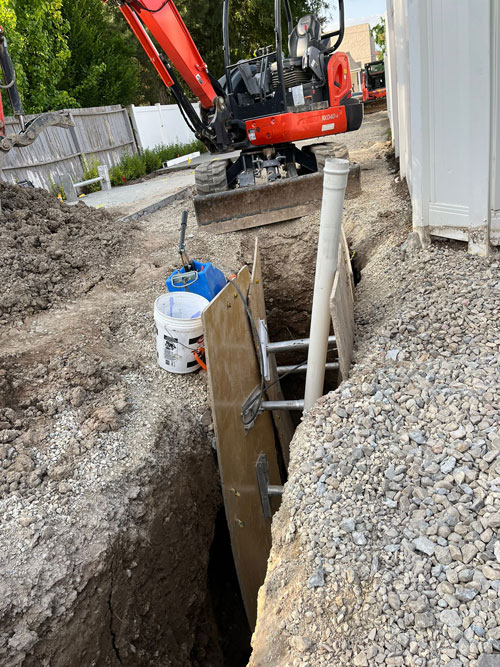
For decades, cast iron was the gold standard for sewer lines, but it has a significant flaw: it rusts from the inside out. This process, known as tuberculation, creates a jagged, sandpaper-like surface that catches waste and hair. Over time, the bottom of the pipe can even rot away completely, leaving a "trench" in the soil where sewage sits. Upgrading to modern materials eliminates these rough surfaces, ensuring that waste moves swiftly and efficiently away from your home.
The Benefits of Modern PVC and HDPE
When we replace an old cast iron line, we typically use Schedule 40 PVC or High-Density Polyethylene (HDPE). These materials are completely impervious to rust and chemical corrosion. Furthermore, HDPE is joined using "heat fusion," creating a single, seamless pipe that is virtually impossible for tree roots to penetrate. These modern upgrades offer a 50-to-100-year lifespan, providing you with a "set it and forget it" solution that significantly increases your home’s resale value.
Why Professional Installation is Non-Negotiable
Switching materials isn't as simple as swapping one pipe for another; it requires specialized transition couplings and a deep understanding of thermal expansion. If a PVC line is incorrectly connected to an existing cast iron stack, it can lead to leaks at the most critical junction of your home. Our team specializes in these "hybrid" transitions, ensuring that your new, high-tech sewer line is perfectly integrated with your home’s existing plumbing for maximum durability.
Why Choose Let's Fix Plumbing
- Locally Owned & Operated
- 24/7 Emergency Services
- Licensed & Uniformed Technicians
- 5-Star Google and Yelp Reviews
- Upfront Estimates
- Easy Online Appointments
3 Things Every New Homebuyer Should Know About the Sewer Line
1. The Standard Home Inspection Doesn't Cover It
Most homebuyers assume that a general home inspection includes the sewer line, but this is a dangerous misconception. A standard inspector only checks if the toilets flush; they do not look at the condition of the buried pipes. Before you sign the closing papers, you should always insist on a Sewer Scope. This small investment can reveal thousands of dollars in hidden damage—like root intrusions or "bellied" pipes—before you inherit the problem.
2. "Age of Home" is the Best Predictor of Failure
If you are buying a "charming" historic home, you are likely buying a clay or cast-iron sewer line that is at or beyond its life expectancy. Even if the drains seem to work during the walkthrough, the "surge" of a new family moving in can cause a weakened system to fail immediately. Understanding the material of the sewer line is just as important as knowing the age of the roof or the HVAC system.
3. You Have Leverage Before the Sale
If a sewer scope reveals issues, you can negotiate with the seller to have the line repaired or replaced before you move in. Alternatively, you can ask for a "closing credit" to cover the cost of the work. Once you take the keys, the sewer line is 100% your financial responsibility. Hiring a professional to perform a pre-purchase inspection is the smartest move you can make to protect your new investment.
Contact Let's Fix Plumbing Today!
Let's Fix Plumbing is a fully licensed and insured plumbing business servicing the Washington Terrace area. We offer a broad range of sewer line replacement services in Utah. Give us a call today at (801) 346-9896 to schedule service.